Board Matters
Board’s Duties and Responsibilities
The Board’s primary responsibility is to foster the Company’s success so as to deliver sustainable value over the long term, and to engage stakeholders based on the principle of sustainability and sound governance. It oversees the strategic direction, performance and affairs of the Company and its subsidiaries (the Group) and provides guidance to Management, led by the Group Chief Executive Officer (Group CEO). In this regard, the Board works with Management to achieve the Company’s objectives and Management is accountable to the Board for its performance.
The Company has a Board Charter which sets out the Board’s role and responsibilities, which include:
(a) approving the Company’s strategies and objectives, and monitoring its progress in achieving them;
(b) approving the financial plan (including annual budgets and capital management plans) and monitoring the financial performance of the Company;
(c) approving corporate and financial restructuring, mergers, and major acquisitions and divestments; and
(d) approving the risk appetite of the Company, and reviewing the adequacy and effectiveness of the risk management and internal control systems.
The Board has established written financial approval limits which set out matters for the Board’s approval, which include capital expenditure, investments, divestments, bank borrowings and issuance of shares as well as debt and equity-linked instruments exceeding certain thresholds. The Board delegates authority for transactions below those limits to Board Committees and Management for operational efficiency, and communicates those limits to them through the Company's intranet.
Board Committees
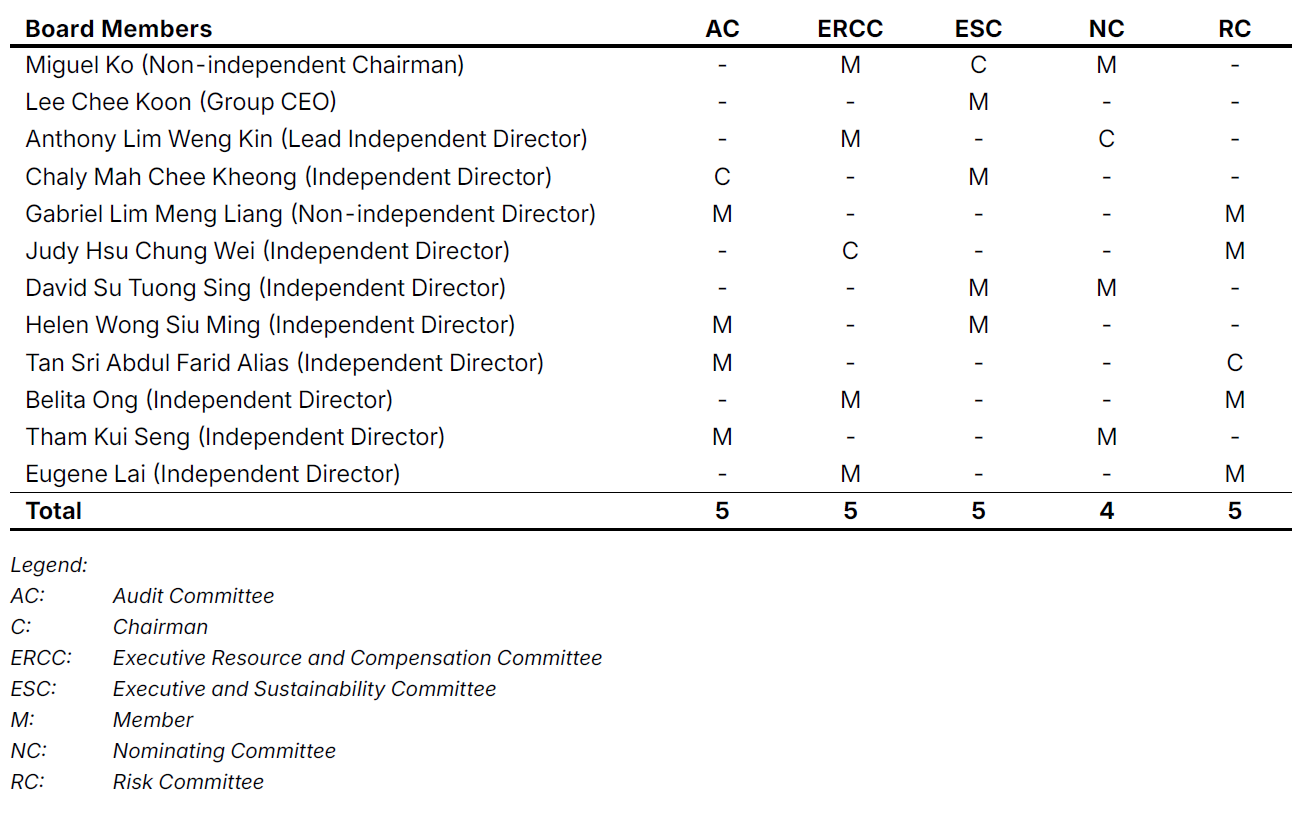
The Board has established various Board Committees to assist in the discharge of its functions. The Board Committees are the Audit Committee (AC), Executive and Sustainability Committee (ESC), Executive Resource and Compensation Committee, Nominating Committee, and Risk Committee (RC).
The ESC assists the Board in reviewing investment and divestment proposals, mergers and acquisitions and any resulting corporate and financial restructuring, within the Board-approved limits. The ESC reviews and recommends to the Board for approval: the Group’s annual budget and forecasts, capital management and treasury policies, credit and funding proposals (including capital markets issuances and on-market share repurchases), long-term strategic plans and sustainability strategies. It also provides input to the Board and Board Committees on sustainability matters. The Board also adopts a cross-Committee membership approach between the AC and the RC to facilitate more effective communication and better coordination of risk oversight.
Each Board Committee is formed with clear written terms of reference (setting out its composition, authorities and duties, including reporting back to the Board) and operates under delegated authority from the Board with the Board retaining overall oversight. The chairpersons of these Board Committees report on a quarterly basis to the Board the decisions and significant matters discussed at Board Committee meetings, and minutes of such meetings are circulated to all Board members.
Composition of Board Committees
-

-
Read more about CLI’s Corporate Governance