.jpg)


What Smart Capital is doing in Asia-Pacific Private Credit
By Arjun Pandit, Managing Director, Private Funds (Credit), CapitaLand Investment
15 Dec 2025


CapitaLand Group
With a solid business ecosystem, we deliver long-term sustainable value to our stakeholders.
Global
English

CapitaLand Group
With a solid business ecosystem, we deliver long-term sustainable value to our stakeholders.
CapitaLand Group
With a solid business ecosystem, we deliver long-term sustainable value to our stakeholders.
What Smart Capital is doing in Asia-Pacific Private Credit
By Arjun Pandit, Managing Director, Private Funds (Credit), CapitaLand Investment
15 Dec 2025
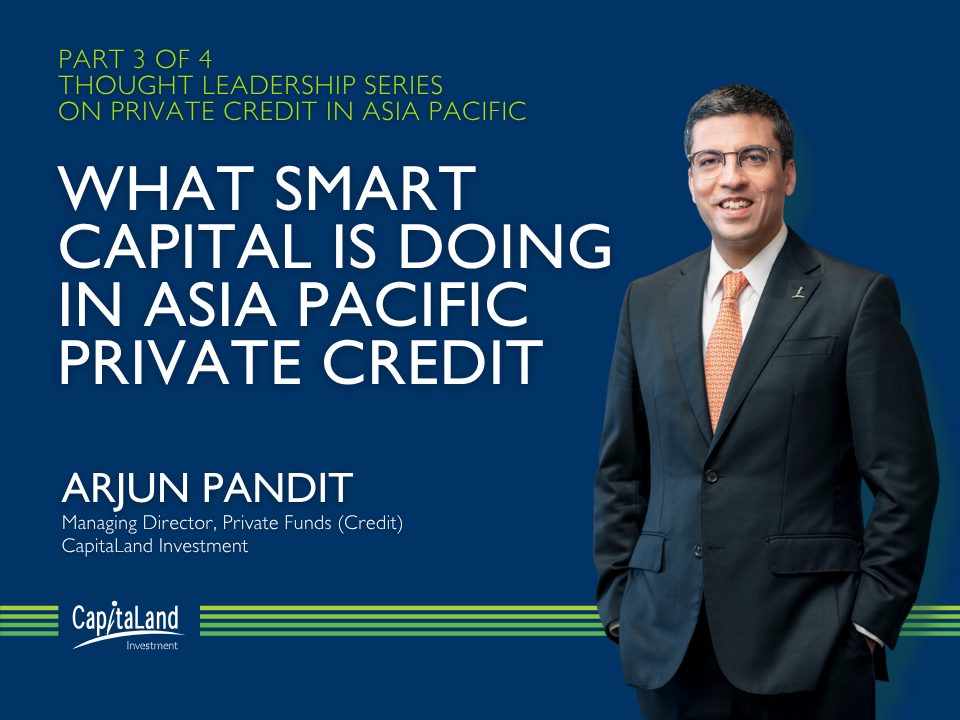
Smart capital is reshaping Asia-Pacific’s private credit landscape. What was once a niche, opportunistic corner of the market is now a fast-developing asset class - one that rewards investors who understand the region’s unique mix of scale, complexity, and growth.
Asia-Pacific’s credit markets are vast yet underpenetrated, and evolving faster than their Western counterparts. This presents an opportunity for investors who can combine structure with substance - those who are selective, patient, and guided by discipline, data, and deep local knowledge.
Across the region, a new generation of allocators is turning to private credit as a way to balance returns with resilience. Smart capital is gravitating toward real assets, transparent structures, and long-term partnerships.
Asia-Pacific is now home to the world’s largest credit market, worth around US$63 trillion. Yet roughly 80% of that still flows through traditional banks.
Yet for all its scale, Asia-Pacific’s private credit “dry powder” remains strikingly small - around US$21 billion, or just 0.03% of the region’s US$63 trillion credit market. The imbalance highlights how early the asset class still is in its nascent stage - and how much potential remains for institutional capital to take a larger, more constructive role in financing the region’s real economy.
As Basel III and other regulatory reforms raise capital requirements, banks are pulling back from sectors they once dominated - particularly real estate and mid-market borrowers.
That concentration creates significant inefficiencies and limits access to flexible capital. Private credit currently accounts for just 6% of real estate financing in Asia-Pacific, compared with 21% in Europe and 41% in the US - leaving enormous room for growth. Even a 1% reallocation from bank lending to non-bank channels could unlock around US$500 billion in new private financing capacity.
That’s where smart capital is stepping in - not to replace banks, but to complement them. The result is a more diversified, resilient credit ecosystem that connects institutional capital with real-economy borrowers seeking flexible, responsible financing.
Bank retrenchment across Asia-Pacific is reshaping how credit reaches borrowers. The most disciplined investors aren’t chasing the risk that banks leave behind - they’re filling gaps where regulation has made traditional lending less efficient.
In markets like Australia, the shift is already measurable. The country’s commercial real estate private credit market was valued at A$85 billion at the end of 2024 and is expected to nearly double to A$153 billion by 2028. In South Korea, tighter capital rules have made it more expensive for banks to hold real estate and construction loans. Smart capital is meeting that need responsibly - financing quality development and repositioning projects with clear collateral, visibility on exits, and a focus on borrower alignment.
For smart capital, regulation isn’t a roadblock - it’s a roadmap. Basel III may have tightened bank lending, but it has also helped define the space where private credit can operate safely and sustainably.
And regulation is only part of the story. As Asia-Pacific accelerates its decarbonisation journey, investors are increasingly looking for opportunities that support the transition - from retrofits and energy-efficiency upgrades to green-certified assets.
Performing real estate private credit in Asia-Pacific typically delivers returns between 8 - 15%, while opportunistic or distressed strategies can reach 18 - 20% - offering an attractive blend of yield and security relative to other asset classes.
Smart capital thinks in cycles, not quarters. The best private credit strategies today are built to endure, not react.
Development loans are structured around milestones and refinancing triggers; portfolio-level financings help borrowers manage liquidity across diverse holdings. At CapitaLand Investment, our senior secured lending follows this approach.
In one Australian transaction, a construction loan was capped at 65% loan-to-cost, stepping down to 55% loan-to-value on stabilisation - a structure that provided repayment certainty, downside protection, and a pre-defined exit through refinancing with a bank.
These frameworks turn risk into something predictable and repeatable - allowing lenders to focus on fundamentals rather than volatility.
Institutional appetite for private credit is rising fast. Pension funds, insurers, and sovereign investors are expanding allocations for diversification and steady yield. Family offices, particularly in Singapore and Hong Kong, continue to lead innovation and early adoption.
What sets smart capital apart is its focus on partnership. By aligning with investors who prioritise governance, transparency, and long-term value creation, managers can build programmes that last. At CapitaLand Investment, our credit strategies combine regional depth with institutional discipline, ensuring alignment between allocator and manager at every stage.
Asia-Pacific’s opportunity is vast - but far from uniform. Legal frameworks, credit cultures, and market maturity vary widely between Seoul, Sydney, and Singapore. For smart capital, understanding those nuances is essential to risk management.
CapitaLand Investment’s integrated credit platform spans origination, underwriting, and asset management. With decades of experience in real assets across developed markets, we bring both local insight and institutional governance - a combination that helps turn regional complexity into lending precision.
Ultimately, smart capital in Asia-Pacific private credit is defined by discipline and purpose. It’s about building structures that endure, not just react; viewing regulation as a guide, not a constraint; and recognising that local knowledge is not optional, but fundamental.
Across the region, we’re not just seeing more private credit - we’re seeing better private credit. Smarter structures, stronger governance, and deeper partnerships are transforming Asia-Pacific private credit from an emerging opportunity into a mature, institutional market.
####