How Data & Infrastructure Are Shaping India's Digital Century
By Kishore Moorjani, Chief Executive Officer, Alternatives, CapitaLand Investment
09 Feb 2026
Share


CapitaLand Group
With a solid business ecosystem, we deliver long-term sustainable value to our stakeholders.
Global
English

CapitaLand Group
With a solid business ecosystem, we deliver long-term sustainable value to our stakeholders.
CapitaLand Group
With a solid business ecosystem, we deliver long-term sustainable value to our stakeholders.
How Data & Infrastructure Are Shaping India's Digital Century
By Kishore Moorjani, Chief Executive Officer, Alternatives, CapitaLand Investment
09 Feb 2026
Share
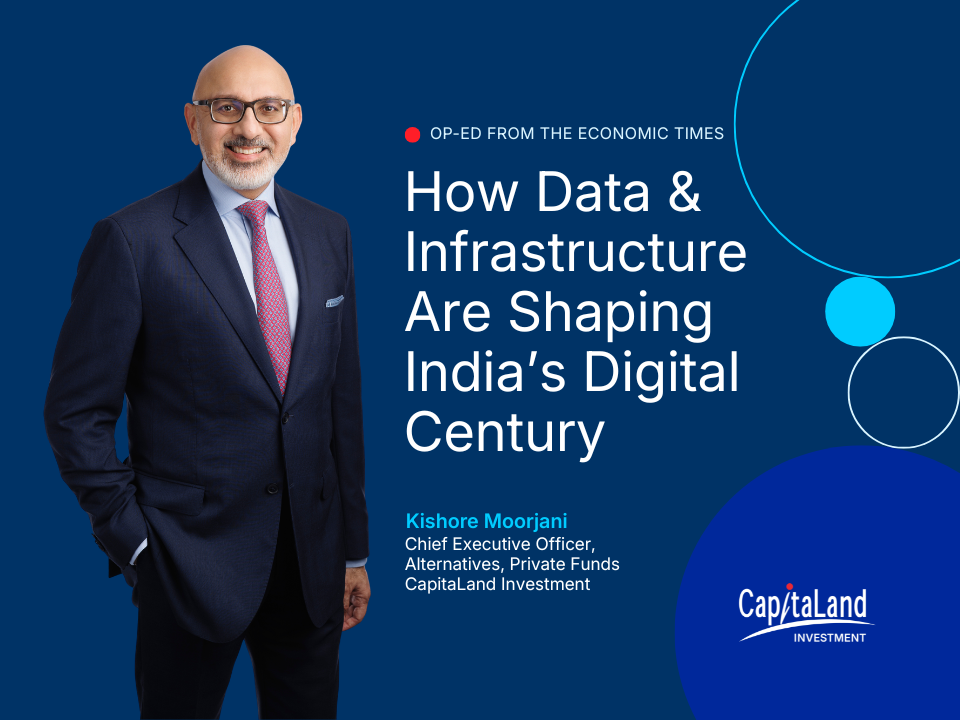
This article was first published in The Economic Times on 9 February 2026
India is entering a defining phase of its economic journey-one where growth is increasingly shaped not just by demographics or consumption, but by the rapid build-out of digital infrastructure. The Global Business Summit 2026 theme, "A Decade of Disruption. Century of Change", captures this moment well. For India, the coming decade will see even greater scaling of the foundational infrastructure of a digital economy for the next century.
Over the last 10 years, India has quietly assembled one of the world's most powerful digital backbones. Deep telecom penetration, near-universal use of smartphones, real-time payments and digital identities have fundamentally altered how businesses operate and how consumers engage with the economy. What follows next is inevitable: the large-scale expansion of the physical infrastructure required to support this digital intensity-data centres and the energy systems that power them. This is further enabled by over 18 global and regional subsea cable connections landing on India's west and east coasts, offering unparalleled high bandwidth connectivity and by dedicated 765kV and 440kV national power grids (under deployment) that ensure secure, large, uninterrupted power availability. Despite being one of the world's fastest-growing generators and consumers of data, India remains materially under-penetrated in data centre capacity. On a per-capita basis, India has roughly one-sixtieth the data centre capacity of the US and about one-twelfth of China. This gap is not a constraint; it represents one of the clearest infrastructure opportunities of the next decade.
Crucially, data consumption is no longer tightly correlated with per-capita GDP. In India, ultra-low mobile data costs have democratised access to digital services. The result is exponential growth in traffic across enterprise software, financial services, streaming, commerce, education and consumer platforms. As digital usage scales, compute demand must follow.
That demand is being driven by a powerful convergence of forces. Enterprises and regulated institutions are increasingly localising data to meet sovereignty and compliance requirements. Cloud adoption is accelerating as Indian companies leapfrog from on-premise systems to cloud-native architectures. AI training and inferencing workloads are expanding rapidly, with economics heavily influenced by power availability and cost per megawatt. And consumer internet usage continues to surge, driven by mobile-first behaviour and low data pricing. The latest union budget proposes a long-term policy framework for data centres until 2047, offering tax holidays and streamlined approvals to attract global hyperscalers. Together, these forces create sustained, multi-cycle demand for data centre capacity.
On the supply side, India enjoys a compelling structural advantage. All-in development costs for data centres are about 40-50% lower per MW compared with the US and up to 60% cheaper than Japan. Cost of power is also 30-40% cheaper with a higher renewable component in the grid supply. These advantages, driven by favourable greenfield land economics, lower labour and materials costs, scalable power availability, dedicated subsea connectivity and fewer ultra-high redundancy and regulatory premiums than more mature markets, make India a very important destination to house global workloads.
Equally important are the rule of law, intellectual property protections and deep pool of skilled labour, which together create a highly business-friendly location for global suppliers to set up local manufacturing capabilities that can support the latest cooling and power technologies at scale and with speed. Importantly, the opportunity is not limited to data centres. As capacity scales, so too does demand for enabling infrastructure-power generation, grid connectivity, renewables, energy storage, cooling systems and network connectivity. In many ways, India's data centre growth story is equally a power and energy transition story, creating long-duration investment opportunities across the broader digital infrastructure ecosystem.
For long-term investors, this is a rare alignment. Structural demand growth meets under-penetration, favourable build economics and assets that are critical to the functioning of the real economy. Data centres and their supporting infrastructure offer visibility of cash flows, long operating lives, and relevance across multiple economic cycles.
India is a strategic market for CapitaLand Investment, and we are well-positioned to originate and scale institutional-quality digital infrastructure by tapping various capital pools including our private fund platforms and listed vehicles.
As India looks ahead to a century of change, digital infrastructure will be as central to growth as transport, ports and power were in earlier decades. Capital that recognises this shift early-and is willing to invest with scale, discipline and a long-term horizon-will help shape the backbone of India's digital future.