CapitaLand Investment, Changi General Hospital and KONE collaborate to advance the integration of robotics in buildings
National standard launched to guide industry players on synchronising communications between robots and smart infrastructure

28 May 2022

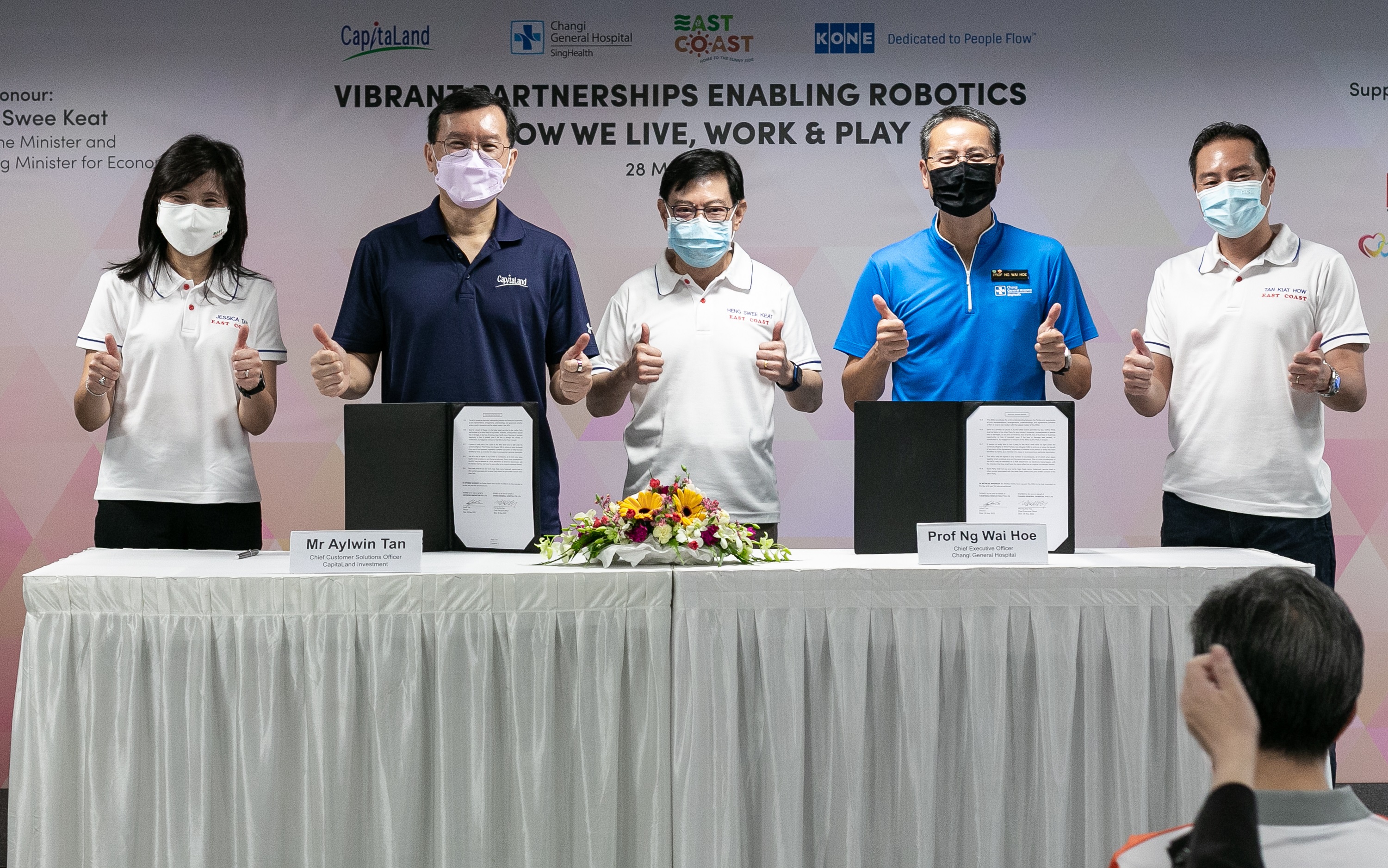
Deputy Prime Minister, Coordinating Minister for Economic Policies and Adviser, East Coast GRC Mr Heng Swee Keat (centre), Mr Aylwin Tan, Chief Customer Solutions Officer, CLI (second from left) and Prof Ng Wai Hoe, Chief Executive Officer, CGH (second from right), together with Advisers to East Coast GRC, Mr Tan Kiat How, Minister of State, Ministry of Communications and Information & Ministry of National Development, and Ms Jessica Tan at the launch of the cross-industry collaborations to advance the integration of robotics in buildings.

Singapore, 28 May 2022 – In support of Singapore’s Smart Nation initiative, Changi General Hospital (CGH), CapitaLand Investment Limited (CLI) and KONE are collaborating to testbed the integration of multifunctional robots and building infrastructure with local and international industry players. The testbeds at Heartbeat @ Bedok and the CLI-led Smart Urban Co-Innovation Lab (the Lab) at Singapore Science Park 2 are guided by a new national standard, Technical Reference (TR) 93, which sets out the guidelines to support harmonised data exchanges between autonomous robots and building infrastructure for effective deployment through horizontal and vertical spaces.

Through efficient communications with lifts and doorways, various robots can travel autonomously and safely through indoor and outdoor spaces and gain access to various storeys in a multi-storey building. These crucial developments led by cross-industry efforts are a boost to Singapore’s robotics ecosystem in line with the national Research, Innovation, and Enterprise 2025 plans, as they help to reduce the time and costs needed to integrate robots with buildings, enhance efficiencies, support the safe deployment of robots within dynamic environments, as well as create new opportunities and jobs. 

Forging vibrant partnerships in East Coast

In the quest to co-create innovative solutions to benefit communities and industries, CGH and CLI, which are two of the founding partners of Vibrant @ East Coast, joined forces with KONE, a global leader in the elevator and escalator industry, under the East Coast Vibrant Community Footprints. The official launch of the partnership was witnessed by Guest-of-Honour, Mr Heng Swee Keat, Deputy Prime Minister and Coordinating Minister for Economic Policies, Chairman of the National Research Foundation and Adviser to East Coast Group Representation Constituency (GRC) at Heartbeat @ Bedok.

CGH and CLI also signed a Memorandum of Understanding to create co-innovation and deployment opportunities to drive discovery, adaptation and adoption of smart cities solutions, and develop initiatives to excite, educate and engage the community in health and wellness. Innovations arising from the partnership are expected to overcome common challenges, increase productivity and help the industry, including small-and medium-sized enterprises (SME), to grow.

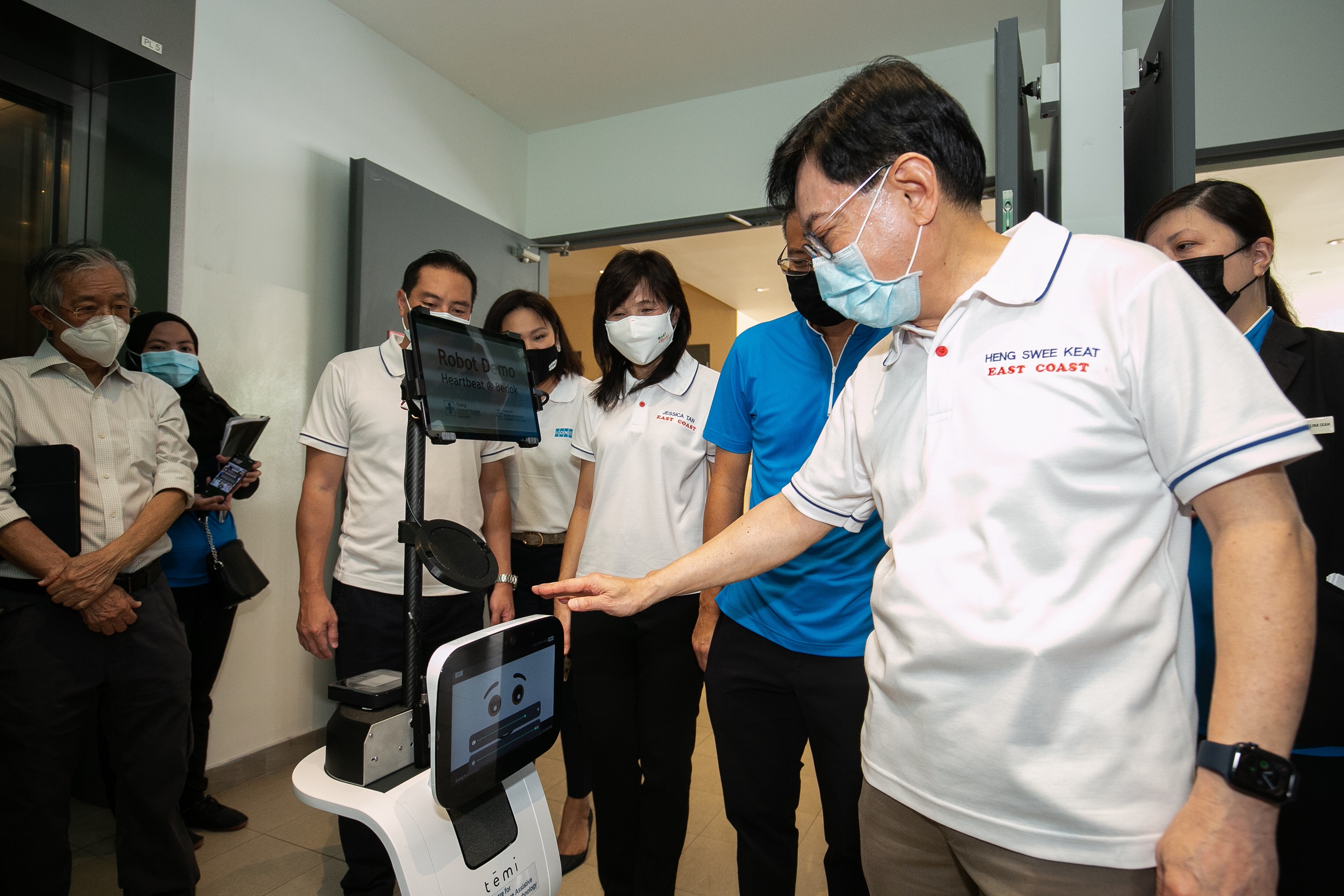
Deputy Prime Minister, Coordinating Minister for Economic Policies and Adviser, East Coast GRC Mr Heng Swee Keat (right), taps on Temi-Bot to activate its ‘follow-me function’. Temi-Bot is a commercial telepresence robot with tele-conferencing, wayfinding, and speech recognition capabilities, and is aligned with the TR 93 standards.

Setting new standard and syncing robots with infrastructure for effective deployment

Singapore is one of the most automated countries in the world. Robotics and automation are also an area of excellence in East Coast that CGH embraces. The development of the world’s first standardised Robotics Middleware for Healthcare (RoMi-H) by CGH’s Centre for Healthcare Assistive and Robotics Technologies (CHART) and other partners1 has paved the way for multiple robots with different proprietary systems from different technology providers to communicate and sync together through common data exchanges.

The innovative interface enables robots to navigate autonomously in human-rich environments, proactively and independently de-conflict their navigation routes with robots of different makes across narrow common pathways, and execute their individual tasks in a co-ordinated manner. This also allows for a universal charging system and fleet management to be developed so that the different robots can be more efficiently managed. RoMi-H has been successfully testbedded for deployment at public sector hospitals and at COVID-19 Treatment Facilities to augment operations and care.

In addition, to guide robot manufacturers and building owners in deploying multiple robots in smart buildings and accelerate the take-up of robotics technologies in multi-storey buildings, the development of Technical Reference 93 (TR 93) was driven by CGH’s CHART and local engineering firm HOPE Technik, and supported by the National Robotics Programme and Enterprise Singapore. With the ability to integrate autonomous robots with next-generation lifts and automated doorways, technology providers, system integrators and building owners can explore and easily adopt the innovative use of robotics technologies in buildings. [Refer to Annex for information on TR 93]

Leveraging CGH’s technology expertise, and CLI’s global network of partners through its Smart Urban Co-Innovation Lab, the first-of-its-kind testbeds are designed to enable industry players to interface RoMi-H with KONE’s next-generation lifts, which comes with cloud connectivity capabilities and open application programming interface (API) that is aligned with TR 93.

Heartbeat @ Bedok is one of the testbed sites, where CGH and KONE have successfully integrated robots with a next-generation lift. The other testbed site at The Galen at Singapore Science Park 2, provides a realistic, accessible and secure operating environment for companies to “plug and play” their own technologies and test the integration with lifts. This will allow building owners in any sector to interweave functions of diverse robots into complex operational workflows. Over 25 local and international industry players have shown interest to be part of the testbed, and more technology players, start-ups, SMEs, as well as adopters including facility management companies, are expected to join and benefit from this initiative in the near future.

Prof Ng Wai Hoe, Chief Executive Officer, CGH, said: “As a smart and Caring General Hospital, we innovate and collaborate widely within and beyond healthcare to create new value, benefit our communities, and contribute to the nation’s efforts in Research, Innovation and Enterprise. The invaluable partnerships with CLI, KONE, Enterprise Singapore and other industry players enable us to leapfrog healthcare solutions to new ground and open up endless possibilities. We are excited that RoMi-H, which first started as a solution for healthcare, can now be integrated with smart infrastructure, potentially accelerating the scaling up of automation and robotics technologies in Singapore and the world.”

“CLI has been at the forefront of innovation in support of the nation’s efforts to build a smart and sustainable city. As Southeast Asia’s first industry-led lab for smart cities solutions development, our Smart Urban Co-Innovation Lab has engaged with over 700 companies across a wide range of industries to identify opportunities and co-create solutions for smart sustainable cities. Our collaboration with CGH and KONE allows us to further advance innovation by bringing partners from our global network to testbed cutting-edge robotics solutions for the built environment industry.”

- Mr Aylwin Tan, Chief Customer Solutions Officer, CLI and Director of Smart Urban Co-Innovation Lab

Mr Aylwin Tan, Chief Customer Solutions Officer, CLI (left) and Prof Ng Wai Hoe, CEO, CGH (right) signed a Memorandum of Understanding (MOU) to create co-innovation and deployment opportunities to drive discovery, adaptation and adoption of smart cities solutions, and develop initiatives to excite, educate and engage the community in health and wellness. The signing was witnessed by Deputy Prime Minister, Coordinating Minister for Economic Policies and Adviser, East Coast GRC Mr Heng Swee Keat (centre).

Mr Samer Halabi, Executive Vice President, KONE Asia Pacific, Middle East & Africa, said: “KONE is honoured to be a key contributor to the development of TR 93, Singapore’s first technical reference to standardise the communication with lifts and automatic doorways and facilitate the horizontal and vertical movement of robots within smart buildings. New technologies, such as in the area of robotics, are rapidly changing the way our customers construct and operate buildings. KONE has increased investments in advanced technologies and broadened our digital capabilities to collaborate and co-innovate with different stakeholders in the built environment sector. We see great opportunities to progress our efforts in Singapore, with its strong focus to be a smart and sustainable nation.” 

Ms Choy Sauw Kook, Director-General (Quality & Excellence), Enterprise Singapore, said: “The Singapore Standards Council, overseen by Enterprise Singapore, is proud to have worked with CHART and various stakeholders to enhance the integration and adoption of safe and effective robotics solutions through the development of TR 93. We envision that this new standard will help spur more deployment of robots in the built environment as it provides a common data interchange platform for various system and equipment providers to work together.”


Note:

1 RoMi-H is developed by CHART, Integrated Health Information Systems, HOPE Technik, and Open Source Robotics, and supported by the National Robotics Programme and the Ministry of Health.

With increased deployment of Automatic Guided Vehicles (AGVs) and Autonomous Mobile Robots (AMRs) – generally termed as robots, within flatted buildings for autonomous material transportation and deliveries – the requirement for multiple fleets of robots to share common infrastructure (e.g. lifts and automated doorways) as part of their route will be critical to ensure effective industrial automation.

Developed from January 2020 to October 2021 by a multi-stakeholder Working Group2 comprising co-convenors from CHART and HOPE Technik, as well as academic and industry partners, TR 93 sets the standard for the architecture and communications/data exchanges between robots and lifts, and between robots and automated doorways, regardless of the model of the automated door system, lift and robot. Adoption of the standard will facilitate the smooth implementation of robotic solutions in smart multi-storey buildings.

The types of lifts and automated doorways that building owners could integrate with the different functional robots may vary. Building owners can take reference from TR 93 and work with system integrators and/or industry partners to ensure that a common architecture and data exchange requirements are put in place for scaling of automation and robotics deployment.

Digitisation is necessary for process automation. For robots to effectively complete the assigned tasks, they need to be able to seamlessly transverse horizontally (along corridors and through automated doorways) and vertically (via lifts) around the building. In compliance with TR 93, conventional lifts and automated doorways need to be appropriately digitised by upgrading the controllers to be able to communicate via an API. With the digitisation, message or command exchanges via API between lifts or automated doorways and robots will be possible either directly between the two systems or via their respective management servers. The management servers can either be hosted on premise or in the cloud for more advanced smart building management systems (BMS).

TR 93 specifies the command and status signals from robots (by the robot Original Equipment Manufacturer (OEM)) and the command and status signals to robots (by the lift or automated doorway OEM) in an integrated message sequence. With the harmonisation of the message exchanges and sequencing between robots, lifts and automated doorways, TR 93 opens up the opportunities for building owners to work with any lift, automated doorway, and robot industry players, enabling a common framework where integration and scaling of automation and robotics for multitude of applications is possible. By adopting TR 93, local and international industry players will be able to provide automation solutions beyond Singapore.


Note:

2 Members of the Working Group include: Advanced Remanufacturing and Technology; Advanced Robotics Centre – NUS; Beckhoff Automation Pte Ltd; Centre for Healthcare Assistive and Robotics Technologies; Continental Automotive; HOPE Technik Pte Ltd; Infocomm Media Development Authority; KONE Pte Ltd; Marina Bay Sands Pte Ltd; ROS-Industrial Consortium Asia Pacific; SIIX-AGT Medtech Pte Ltd; Singapore Institute for Manufacturing Technology; and TÜV SÜD PSB Singapore

For media queries, please contact us at:
media@capitaland.com

Download(s)


News release

Speech by Mr Aylwin Tan, Chief Customer Solutions Officer, CapitaLand Investment

You may also be interested in